The Many Faces of Frida
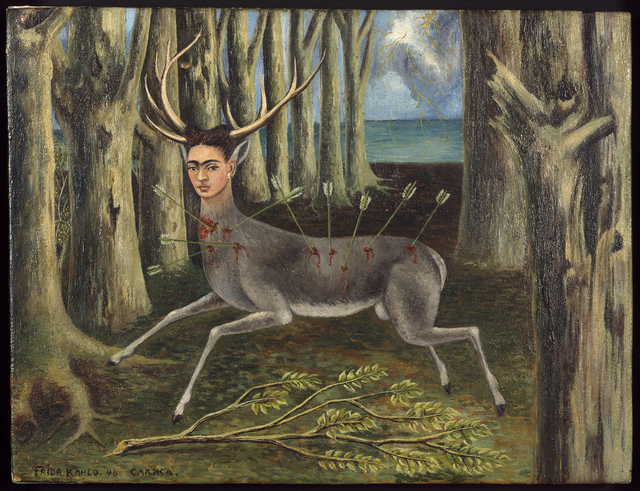
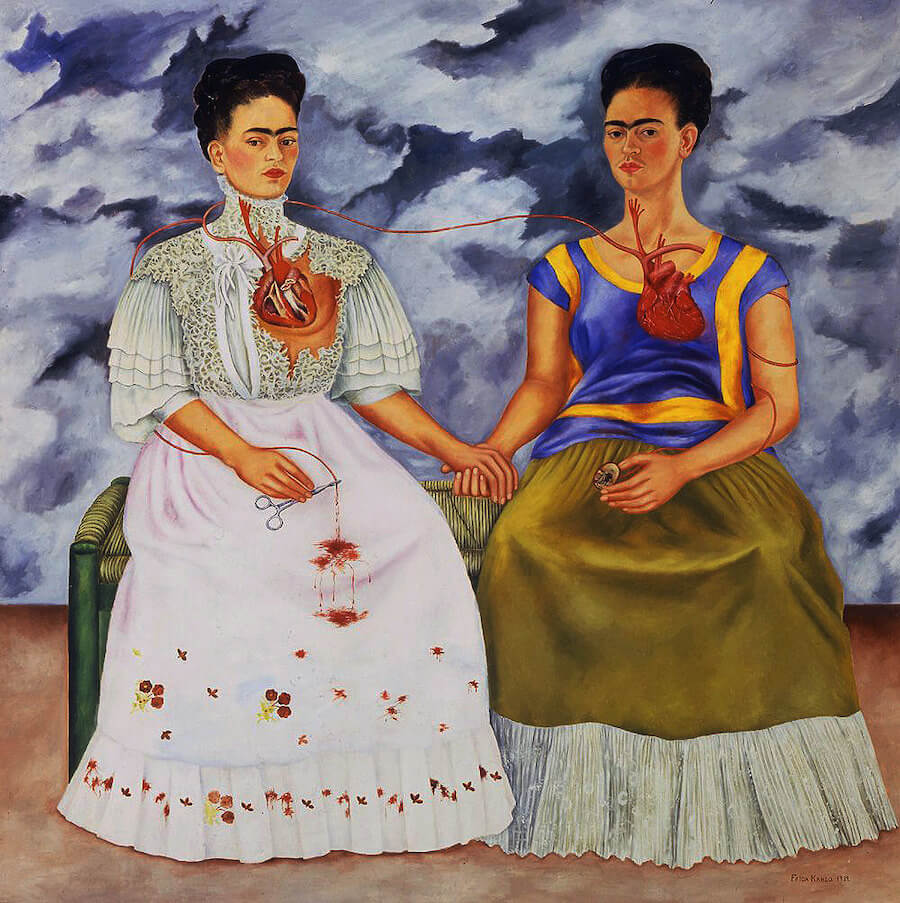
Magdalena Carmen Frida Kahlo y Calderón was born in Mexico in 1907. Although disabled by polio as a child, she was a promising student headed for medical school. She enjoyed art from an early age and would fill notebooks with sketches, although at the time she did not consider art as a career. At 18 she was in a severe bus accident that would alter her life significantly. She was bedridden for months and would experience lifelong pain. During her recovery, she began to paint in bed with a mirror placed above her easel so she could paint herself. This led her to explore concepts of identity and existence in her art. She initially took inspiration from European artists such as Botticelli, but later was more inspired by Mexican folk art.
In 1930, Kahlo moved to the United States with her husband, artist Diego Rivera. She lived in San Francisco, then Detroit, and in this time her style developed, drawing more from folk art, and experimenting with new techniques such as etching and frescos. Her paintings grew to have a strong narrative style, depicting themes of terror, suffering, wounds and pain. She returned to Mexico City in 1934 and stopped painting as frequently due to health complications, though she was rising in popularity as time passed. One notable figure was André Breton, who was impressed by Kahlo and immediately claimed her as a Surrealist and described her work as "a ribbon around a bomb". Over the years she continued to paint and became quite renowned. She had many exhibitions in places like New York and Paris, and was the first Mexican artist to be featured in the Louvre. She began teaching art students in 1943. Her health declined rapidly in the following years and her paintings became bolder and more feverish. Knowing she didn't have much time left, she had her first solo exhibition in Mexico in 1953 where she arrived on a stretcher to attend in a bed. She died the following year, leaving behind a legacy of who many consider to be the greatest Mexican artist.